Wednesday, 13 December 2023


Join the Indian Textile Odyssey
Be a part of a remarkable showcase of India's rich textile heritage, craftsmanship and innovation. Bharat Tex 2024 will take the fashion sustainability narrative forward to the world stage with an exemplary presentation of the entire textile value chain under one roof.
Organised by the Consortium of Textile Export Promotion Councils (EPCs) with the support of the Ministry of Textiles, Government of India, Bharat Tex 2024 is envisioned to become the largest global textile convergence in New Delhi from February 26 to 29; drawing participation from manufacturers, exporters to artisans, craftsmen, weavers, and designers across the country.
Bharat Tex 2024 offers excellent opportunities to gain insights into and engage with the burgeoning textile industry of India. Join the mega celebration of textile, trade, technology and tradition.

Key highlights
arrowarrowarrowarrowarrow
3,500+
Exhibitors
40,000+
Trade Visitors
3,000+
Overseas Buyers
2,00,000+
Sq.Meters Area
50+
Knowledge Sessions


Tapestry of Experiences at Bharat Tex 2024
Exhibition with 8 focused zonesDesigner ensembles
Knowledge sessionsMaster classes
Country & State sessionsGovernment initiatives
CEO roundtableGlobal Launches
G2G meetingsNetworking sessions
Reverse buyer - seller meetsCultural showcases


Focused zones for focused business
Quick links

AdvantEDGE INDIA

Website

Download Brochure

Tuesday, 15 November 2016

Khadi Calling - The Growth of Indian Textile

Indian Khadi

As they say, “Luck favours the Brave”, and this has been proven right by a Radio Jockey hailing from the city of Nawabs, Lucknow. Meenu Singh, who started her career as a Radio Jockey and reached the zenith of success did not become complacent. Instead she forayed into the world of cinema, where again she conquered with the NOVA film house award for her very first short film. While her career choice kept her going, she knew her heart laid with none other than the quintessential Indian fabric, Khadi! Such was her love for this fabric that she decided to set up a T-shirt Store and forward the earnings from the same towards an NGO partner of the Khadi and Village Industries Lovers Association (KAVILA).

Saturday, 12 November 2016

Fibre, Textile & Apparel Exports of USA Reach $28bn In 2015

As per the information divulged by the US International Trade Commission, the fibre, textile and apparel exports of the nation, went up to approximately $28 billion, in the financial year 2015. The major chunk of this substantial total came from fabrics which ranged to $9 billion. The rest of this came from various raw materials apparels with $6.1 billion, yarns with $4.9 billion, cotton and wool fibre with $4 billion and approximately 3.7 billion worth of made-up articles.  At $ 28 billion, USA stands as the fourth largest exporter of fibre and textile products in the world.

In a bid to inform the citizens of the USA, the recent progress that the nation made with respect to investment and innovations, the National Council of Textile Organizations (NCTO) made this declaration on 7th of October, The National Manufacturing Day. 

In addition, the textile industry of the United States currently supplies as many as 8,000 distinct textile items to the armed forces. This is evident from the fact that the US military has spent close to $2 billion on textiles, annually for the entire past decade. 

Growing capital expenditures also are a clear sign of the textile industry’s positive outlook. The textile and apparel sector spent $2 billion on capital expenditures in 2014, the latest year for which data is available.


Saturday, 29 October 2016

Textile Ministry Supports Free Trade Agreement with EU


India Free Trade Agreement with EU

The Indian textile ministry sees the Free Trade Agreement (FTA) with the European Union (EU) as one of the most promising measures to boost exports. It is for this reason that it is in talks with the Commerce Ministry to urge the closing of this agreement. It is speculated that once the FTA is implemented, it will help increase the export of fabrics ,garments as well as Home textiles and will help in dealing with the increasing competition with Bangladesh & China. This, teamed with China’s downtrend in export growth will help India regain or improve its original position in the arena of textile exports.

Friday, 21 October 2016

Textile Stock – Growth Chart of the Company


TextileStock.in is an online inventory of textile stocklots which are ready to be sold. Essentially an Indian portal, it enables the potential buyers with all the possible details regarding the stock, simply at the click of the mouse. It is one of the rare entities within India that deals in the export of textile stocks of every possible product that can be listed under the textile umbrella. Right from kitchen linens to fashion apparels, from home furnishings to technical textiles, the portal has proven to be an efficient marketplace for them all. And this can be easily gauged from the growth chart of the company.

Thursday, 29 September 2016

Impact of GST on Textile Sector


The Indian Textile Sector is highly export oriented, with as much as 5% of the world’s export coming from the nation, which accounts to over USD 40 billion. As of the latest news, an impetus through tax exemption on all exports is being offered to the industry. And as far as the GST is concerned, the industry is pressing for a zero rating, at least on exports. In fact, it expects the authorities to put in place a refund system with respect to the input tax paid.


In the current system of taxes, more often than not final or finished products are either not taxed at all, or are taxed at a minimal rate, while the various categories of textiles are taxed anywhere in the range of 4 to 12 percent. Given the low rate, the taxes are shifted back to production which in turn leads to blocked input taxes, thus resulting in a spike in the production costs. While the current system of taxation finds its base on the production side, introduction of GST will transform it to being consumption based.

Currently, the production inputs are entitled to this exemption, which depends on the size of their operation. Given this flaw, no initiative of applying any taxes to the industry is agreed upon. Moreover, owing to the differential taxation for various categories, such as fabrics an garments, cotton and manmade fibre, power looms and composite mills, an uncalled for tension has plagued the industry. Then again, the structure of inputs is also broadly divided in the form of textile inputs as well as non-textile goods and services inputs.

All of this will most likely be taken care of with the implementation of GST, since a unified tax rate is proposed with respect to all goods and services.

The textile industry at large, has expressed that a GST rate of about 12% would be in line with the current rate of taxation and hence prove to be rather effective. The Clothing Manufacturers Association of India (CMAI) has even roped in Price Waterhouse Coopers and Wazir Advisors in order to prepare their representation to the GoI in order to push for the inclusion of the ready-made garments under the ‘Merit List’ which will help entail a relatively lower tax rate on these garments. In case this doesn’t happen, it is feared that the brunt of the higher rate on the end of consumers will adversely impact the growth and profitability of the sector. The industry has been advocating the fact that textiles and garments are essential items, and hence deserve a special treatment, as far as the GST is concerned.

While, a large majority of the problems will seemingly be resolved with the implementation of the GST, the final output rate is yet to unfold. It is only after the rate is out in the open, will the industry be able to gauge the actual impact of this tax.


Thursday, 22 September 2016

Technical Textiles - Safest Investment Option in Indian Textiles?


Investors are always on the lookout for profitable option, however, considering the present day scenario of volatility, especially with the GST coming in anytime now, it might be a little easier  to speculate and invest in a textile product which is not only safe but profitable as well. In fact for what it’s worth, most businessmen and traders wish to put in their money on something that assures them of the following factors:

  •          Higher Margins of Profit
  •          Sustainability
  •          Lower Periods of Gestation
  •          Assured Returns
  •          Ease in Debt Repayment


While it is the conventional textiles which enjoy the better part of the market’s capital, businesses are now looking forward to diversifying, in order to avert the expenditures incurred in this capital and labour incentive segment.

While carpets, handloom and other textiles involving man-made fabrics show promise, the market for these is rather saturated and thus leaves little or no scope for new entrants. Moreover, some of these products, especially rugs and carpets that require fine craftsmanship, take up a lot of resources in terms of money as well as skilled labour for manufacturing, which makes them a non-viable alternative.

On the other hand, the technical textiles is one segment that is showing a great promise, without too may strings attached. Given that products of this segment are only in their introductory phase, at least in India, the speculated growth rate of technical textiles is rather impressive. With a substantial growth of over 16% in the decade of 2001 to 2010, this segment is expected to register a consistent growth of 20% per year. Pertaining to this growth, the market size for technical textiles by the year 2017, will be close to $36 billion! Moreover, since technical textile products are highly engineered and manufactured for very specific purposes on the basis of their functional properties, thus making them high value products and ensuring higher returns and eventually better profit margins. 

As of the current scenario, the disposable income with Indian consumers is growing at a steady level, which in turn will enable them to make greater purchases on products related to sport textiles, home textiles, medical textile etc.  Moreover, in the coming five years, the middle income group which comprises of over 300 million people will increase to approx. 520 million, thus creating an unparalleled opportunity for growth for the technical textile sector. Here the demographic hold high importance, especially because the middle class is:
  •          Fairly educated
  •          Receptive to disposable products
  •          On the lookout for more and more products pertaining to technical textiles
  •          Contributing to the growth of organised retail sector in the nation

Furthermore, a large chunk of the nation’s population is currently below the age of 25, which ensures an even better growth prospect for this segment, and in fact, for any other segment as well.
Technical textiles make for a great investment option, especially because of their immense range of applications. With the increasingly growing demands from the consumers as well as other industries, the pool of opportunities that lie ahead seem never ending. At present the contribution of India towards global technical textiles is a meagre 9 percent. Given that there aren’t many players in the market, there is a good chance that India can make its own mark in the segment, sooner rather than later.

This can be deduced from the fact that India has certain advantages over the developed nations including but not limited to inexpensive labour, and abundance of raw material, a steadily increasing population, a promising infrastructure development as well as sky-rocketing industrial growth. All of these combined will surely make investment in technical textiles worth the time effort and resources of businessmen and traders alike.


Monday, 29 August 2016

Apparel Is Leading the Online Retail Category in the Asia-Pacific Region

Apparels Online
Apparel Is Leading the Online Retail Category in the Asia Pacific Region

Recently, a market research firm based out of Germany, named Ystats.com unveiled a detailed report on the subject of 'Asia-Pacific Clothing B2C E-Commerce Market 2016'. As per the inferences of this report, apparel seems to be the pioneer when it comes to the online retail category across the Asia-Pacific Region. In fact, a whopping 40-50% of the online shopping enthusiasts within the region have made online purchases pertaining to the fashion segment in the year 2015.

Thursday, 25 August 2016

Apparels Received Their Special Package… Raises Hopes For Home Textile Segment


It was only last month, that a special package was announced by the Ministry Of Textiles, pertaining to the Apparels exports. Following the suit, even the stakeholders of the Home Textile Segment are lobbying for something on the similar lines. It was at a recent event held by The Cotton Textiles Export Promotion Council or Texprocil in Mumbai, when the council along with Ernst & Young released a report on ‘Textile Industry as a vehicle of job creation for inclusive growth’.

Monday, 15 August 2016

Excessive Surge in Pricing in Cotton Affecting the Indian Textile Exports

Cotton Textile India


In the year 2015-2016, the prices of cotton have risen unexpectedly and this has caught the Cotton Spinning Industry, completely off guard. So much so, that the cotton stocks with the manufacturers and suppliers were fairly low, which in turn, will lead to the overall decline in domestic output by double digits. As of now, the industry is expecting a heavy crush of profit margins, due to the increasing imbalance between the supply and demand. To make things worse, the new arrival of the crop will also be delayed this year due to the late sowing of cotton. 

Wednesday, 10 August 2016

Transport Cycle of TextileStock.in

Textile transportation Cycle

As you may already know, TextileStock.in is a one-of-its-kind online inventory of textile stocklots which are ready to be sold. Essentially an Indian portal, the website avails all the requisite information to potential buyers at the click of the mouse. This information is inclusive of:

  • Product Specification
  • Available Quantity 
  • An Approximate Estimate Of Price
  • Product Photographs

TextileStock.in was incepted with the idea of creating a dedicated online marketplace for textile stocklot that helps various manufacturers come on a single platform to sell their goods. The portal efficiently consolidates and markets a substantial chunk of the stock available with suppliers from all across the nation. Not only does the portal helps in increasing the overall visibility of the sellers and the product but also avails them with the opportunity to earn competitive pricing for the same - and all of this, completely free of cost.

Monday, 1 August 2016

Guide To Increase Profit Margins in Textile Industry


All businesses, whether big or small, are always on the lookout for ways to increase their profit margins. This especially holds true in case of manufacturers, for the simple reason that when the magnitude of the stock is greater, even a slight increase in the margins can prove to be substantially profitable. This holds true for the textile industry as well.

Wednesday, 13 July 2016

Amazon to Invest $3 Bn in India - How Will This Benefit The Textile Industry?

Narendra Modi with Jeff Bezos

The Founder and CEO of the e-commerce giant Amazon, Mr. Jeff Bezos recently announced the company’s plan to increase their investment in India by a whopping 3 million. This will bring the overall investment capital of the e-portal in India to over $5 Billion.

Wednesday, 6 July 2016

Government Brings in Labour Reforms via 6,000cr Textile Package


In a recent turn of events, the Union Cabinet has introduced certain changes in the labour laws of the nation, and has approved a significantly humongous package of Rs. 6,000 crore for the textile and apparel segment, in this effect.

Tuesday, 21 June 2016

Future of Indian Textile Industry

Future of Indian Textile Industry
One of the oldest sector in India, textile sector also happens to be the largest in the country. However, in the decade gone by, the industry has been plagued with a plethora of issues ranging from government regulations to economic slowdown and many others. In fact, there even came a time where small players like Pakistan, Bangladesh and Sri Lanka, which any considerable strength in the sector raced ahead of India in many sectors. Nonetheless, Indian textile sector bounced back with full strength and even managed to achieve an exemplary GDP of over 6%. Moreover, it was only during the decade gone by, that the Indian textile and clothing industry was officially integrated with the World Trade Organisation.

Monday, 13 June 2016

Iran- A Huge Potential Market for Indian Textiles

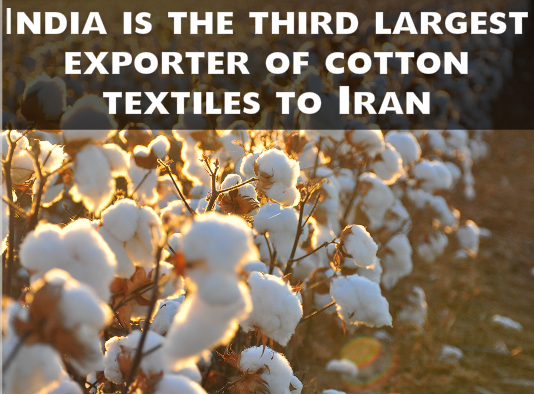
 India is the third largest exporter of cotton textiles to Iran

In the recent past, the import duties with respect to textile fabrics and ready-made garments in Iran have been reduced drastically, as a measure to curb illicit imports. This has also helped the Iranian Government to clear its way towards becoming a part of the World Trade Organisation. On the other hand, India is on the lookout to tap Iran’s markets which seems to have a great potential for apparel & Home textile products.

Friday, 3 June 2016

Turning a Business Crisis into an Opportunity!

How to come out from a Business Crisis

The very definition of business essentially comprises an overlooking risk factor. And at a place where risk is inevitably involved, crisis ought to follow, more often than not. However, the strength of an entrepreneur always lies in his ability to turn this crisis into an opportunity! Former CEO of Intel, Andy Grove, once pointed out, “Bad companies are destroyed by crisis. Good companies survive them. Great companies are improved by them.”

Thursday, 26 May 2016

Mills Online - Selling Stocklot Wasn’t So Simpler Earlier

Sell textile surplus stock

It has been quite some time now that technology has taken over in our lives. Connectivity whether it is through the internet or the mobile platform has taken a huge leap, and boundaries seem to wither with each passing day. 

Saturday, 21 May 2016

The Online Solution To Stop Fraud In Textile Market

Fraud In Textile Market,

With more monetary freedom at one’s disposal, global consumerism is on an upswing. For the consumer fraternity, the textile market and apparel industry have been amongst the favorite sectors to shell out the bucks. The shift in demographic preferences can be easily figured out from the emerging market trends highlighting the global demand for apparels and the corresponding market competitions in place. The textile industry is representative of a variegated spectrum of activities ranging from cottage spinning and weaving sector at one end and capital intensive mills at the other.

Friday, 13 May 2016

Is The Internet The Right Stimulus For Indian Textile Industry?

Internet for textile industry


India, the second-largest producer of textiles and garments, has been eyeing to be a sourcing hub, riding on the back of a skilled labor force and opulence of cheap raw materials. With Indian Textile Industry accounting for a quarter of the global spindle capacity, its potential size is speculated to reach US$23 billion by the end of this decade.

Being the second largest employment generating sector in the country after agriculture, Textile Industry has got a huge bearing on the country’s economy. Hence, a holistic development of this sector is imperative for GDP expansion. Infusing the right kind of technology with this industry is definitely the roadmap to tap the entire market potential.